
Aircraft Hangar Roofing in Pompano Beach, FL
A hangar exists to keep the afternoon storm off an airplane, so when the roof leaks the building has failed at the one thing it was built to do. Around Pompano Beach, FL, near-daily summer thunderstorms make the roof plan part of the flight schedule, ramp plan and hurricane calendar. Aircraft owners know the pattern well, and so does anyone who has ever stood under a drip with a wing or an avionics bench below it.
We repair, retrofit and replace roofs on aircraft hangars, maintenance shops and aviation support buildings. These are not ordinary warehouses. They have long clear spans, huge doors, expensive contents and tenants who cannot pause an aircraft inspection because a crew arrived early. The roof plan has to work with the flight schedule, the ramp and the hurricane calendar, all at once.
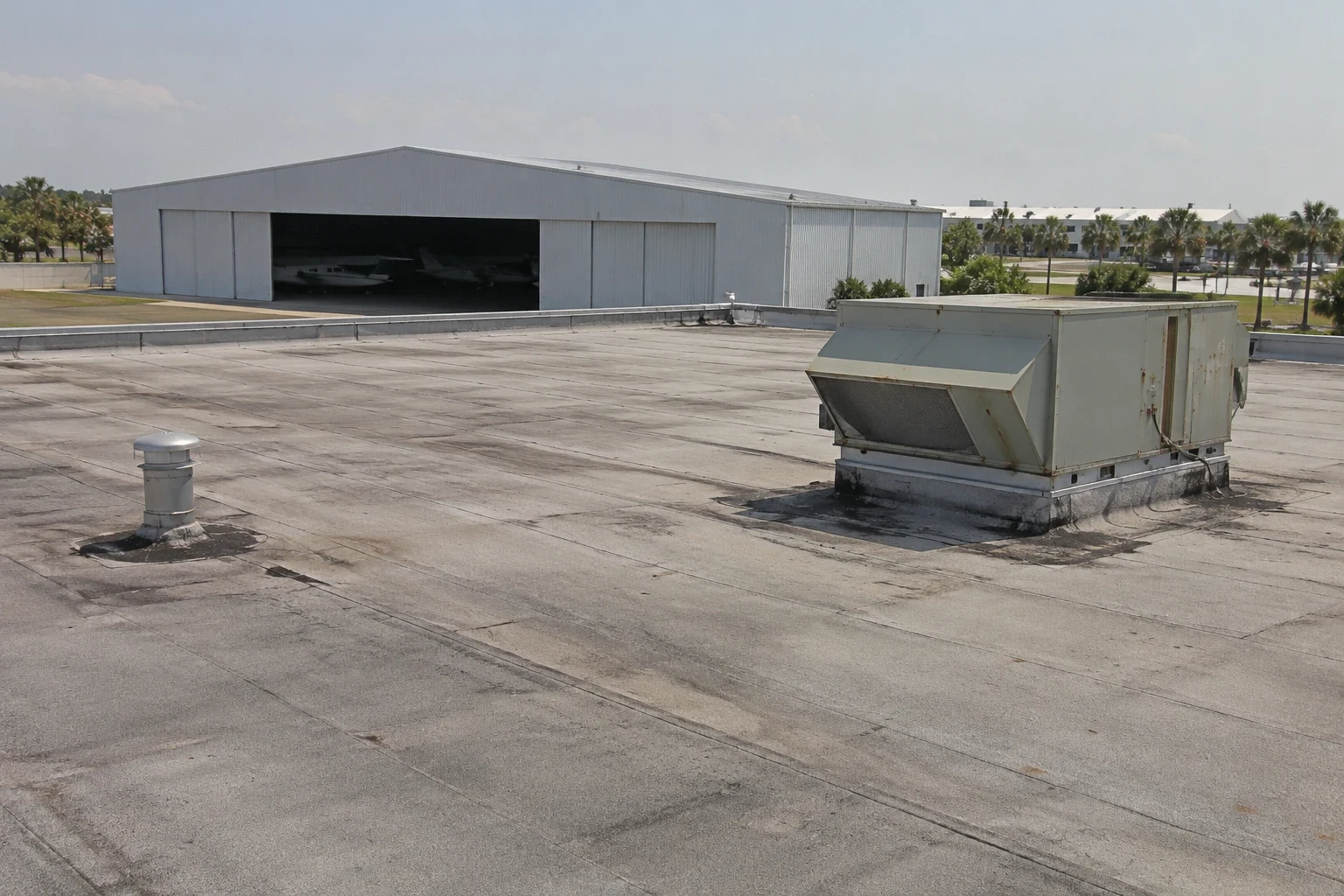
Clear Spans: why a hangar roof is a different animal

A hangar has few interior columns, because aircraft need open floor. That means long steel framing carries the whole roof, and the deck above it has almost no mid-span support. The roof may be ribbed metal, a membrane over insulated deck, or a mix after years of additions. Whatever it is, one leak can put water onto fuselage, composite surfaces or an engine on a stand, and the repair bill for the aircraft often dwarfs the bill for the roof.
Condensation causes as many drips as leaks. Hot, humid air meets a cooler metal underside and beads up, and in a hangar those drops land on aircraft skin. We check insulation and vapor details as closely as flashing. Because hangar roofs are so large, a drone roof inspection is often the best way to find failed laps, loose fasteners and ponding without walking every panel, and it does not disturb the people working below.
A hangar door opening changes the pressure the roof sees when wind gets inside. The roof attachment, door wall, eaves and end-wall corners need to work as one load path, and an open hangar door can complicate temporary protection during a storm. We inspect the door tracks and adjacent flashing for movement, then coordinate work around aircraft clearance and the site's fall-protection rules. Because the roof spans are large, a marked repair map is useful: it lets the owner locate each seam or panel by bay rather than by a distant interior stain.
Door Ends and Wind: where hangars get hurt
The big door is the weak point of every hangar. If wind pushes it open or breaks it during a hurricane, pressure builds inside and tries to lift the roof from below. Two storms, Hurricane Wilma in 2005 and Hurricane Irma in 2017, put hurricane-force gusts across Broward within living memory, and Irma added three tornadoes to the county besides. A hangar with a damaged door end can lose roof panels in minutes.
That is why we pay the most attention to the roof edge at the door header, the eave and the transitions at tall side walls. Broward sits in the High Velocity Hurricane Zone, so panels, trim and fasteners need Miami-Dade product approval and tested attachment, with no substitutions at the last minute. A standing seam metal roof can be a strong match for hangar spans, and sound edge metal is what keeps it attached when the wind comes at the doors.
At the Air Park: tenants, ramps and the Goodyear blimp base
Pompano Beach Air Park is a city-owned, 650-acre airport with three runways, more than 200 based aircraft and two fixed-base operators. It supports more than 20 businesses, from flight training to aircraft maintenance, avionics repair and fueling, and the Air Park's industrial and maintenance areas cover about 496,000 square feet of buildings. The Goodyear blimp is based there too, and the airport as a whole supports 2,597 jobs.
A roofer working near a ramp has to think about things other roofers do not. Loose fasteners and bits of membrane are foreign object debris that can damage an engine, so we sweep with magnets and keep the work area tidy. Crane heights near runways may need airspace review, and tenants need clear access to hangar doors. Coordination with the fixed-base operator and the shop foreman happens before the first load goes up. That is the discipline any roof job at the Pompano Beach calls for.
What Sits Underneath: aircraft, sprinklers and fumes
Many hangars have foam or sprinkler systems running through the roof structure, and any penetration or attachment must leave those systems untouched. Hot work is restricted around aircraft, fuel and solvents. Torches and open flame are out of the question, and even hot-air welding gets a permit and a watch. We choose systems and methods that suit the building, including mechanically attached or cold-applied options where flame is not allowed.
Aircraft may be inside while we work. Where they cannot be towed out, we cover them, hang protection under the work zone and put catch frames along the underside. Shops that handle avionics, paint or composites want solvent and adhesive fumes kept away from their air intakes, and we map those intakes first. Phasing a reroof section by section is common, which keeps half the hangar usable while the other half is being finished.
Across Broward and Beyond: executive airports, FLL and military hangars
Fort Lauderdale Executive Airport covers 1,050 acres and handles more than 150,000 aircraft operations a year, making it one of the busiest general aviation airports in the country, and Fort Lauderdale also hosts Fort Lauderdale-Hollywood International with about 105,000 tons of cargo. Corporate hangars and maintenance shops on fields like these have the same roof concerns as the ones at the Air Park, with the added pressure of heavy schedules and expensive aircraft.
Farther south, Coast Guard Air Station Miami at Opa-locka Executive Airport flies fixed-wing HC-144A aircraft and MH-65 helicopters from hangars and flight-line maintenance buildings. Roof work on military installations follows access, escort and mission-schedule rules, and roofing is generally built to the Unified Facilities Criteria. Owners of military hangar and maintenance facilities face those requirements directly, and private hangars often borrow the same discipline. A flex industrial building with shop bays and tall doors shares many of the same details.
Questions We Hear Often
What happens to aircraft inside during a reroof?
They either move out or stay under protection. We hang covers below the work zone, add catch frames and phase the roof so part of the hangar stays open. Your operations manager picks which aircraft move.
Can a hangar keep operating while the roof is replaced?
Usually in part. Section-by-section phasing keeps one bay clear while the next is being worked, and crews finish each section and dry it in before storms arrive.
How do you keep debris away from the ramp?
Magnetic sweeps, tool counts, covered dumpsters and a clean-as-you-go rule. Loose fasteners and membrane scraps are treated as foreign object debris, and the area is checked at the end of every shift.
Is metal or membrane better on a hangar?
Both are used. Metal gives clean long runs and good wind performance when edges and laps are right, and membrane suits a hangar with penetrations or an irregular roof line. The building's framing and age steer the choice.
Why do drips fall inside a hangar when the roof looks sound?
Condensation. Warm, humid air meets cool metal and forms droplets that fall like rain. We check insulation, vapor control and ventilation, and then separate real leaks from sweating.