Due Diligence Roof Surveys in Pompano Beach, FL
A buyer who tours a warehouse in the dry weeks of February sees a very different roof from the one that sits there in August. The sun is gentler, the afternoon storms have not started, and the stains on the ceiling tiles are easy to blame on something else. The roof, meanwhile, has been through a full wet season and is about to face another one. A due diligence roof survey exists to close that gap between what a showing looks like and what the building will do in July. We run these surveys out of Pompano Beach, FL, for buyers, lenders and sellers who need a clear read on a roof inside a contract clock. The survey tells you the condition, the likely trouble spots, what repairs cannot wait and what the roof will cost you over the next several seasons.
The Deal Clock: fitting a survey into a short window
Acquisition and refinance timelines leave little room, and a roof survey that arrives after the deadline helps nobody. So the work is sequenced to fit. Access is arranged first, with the seller or the property manager, and any occupied-building rules are settled before we climb. The walk comes next, along with any scanning that needs good weather. The written findings follow while the numbers are still negotiable.
We ask for what the seller has: drawings, past repair invoices, warranty documents, leak complaints. We do not wait on them, because a lot of buildings have thin records. When paperwork is missing, the roof itself becomes the record, and the report says which facts were confirmed and which were estimated. That is the version of the story a lender or an investment committee can actually rely on.
A buyer can use the findings to distinguish near-term repair costs from later capital work. We note which observations are visible, which require a test cut and which depend on opening the assembly, so the report does not imply certainty beyond the inspection performed. The result is a useful scope for a transaction timeline and a practical first maintenance list after closing.
On the Roof: what a survey looks at
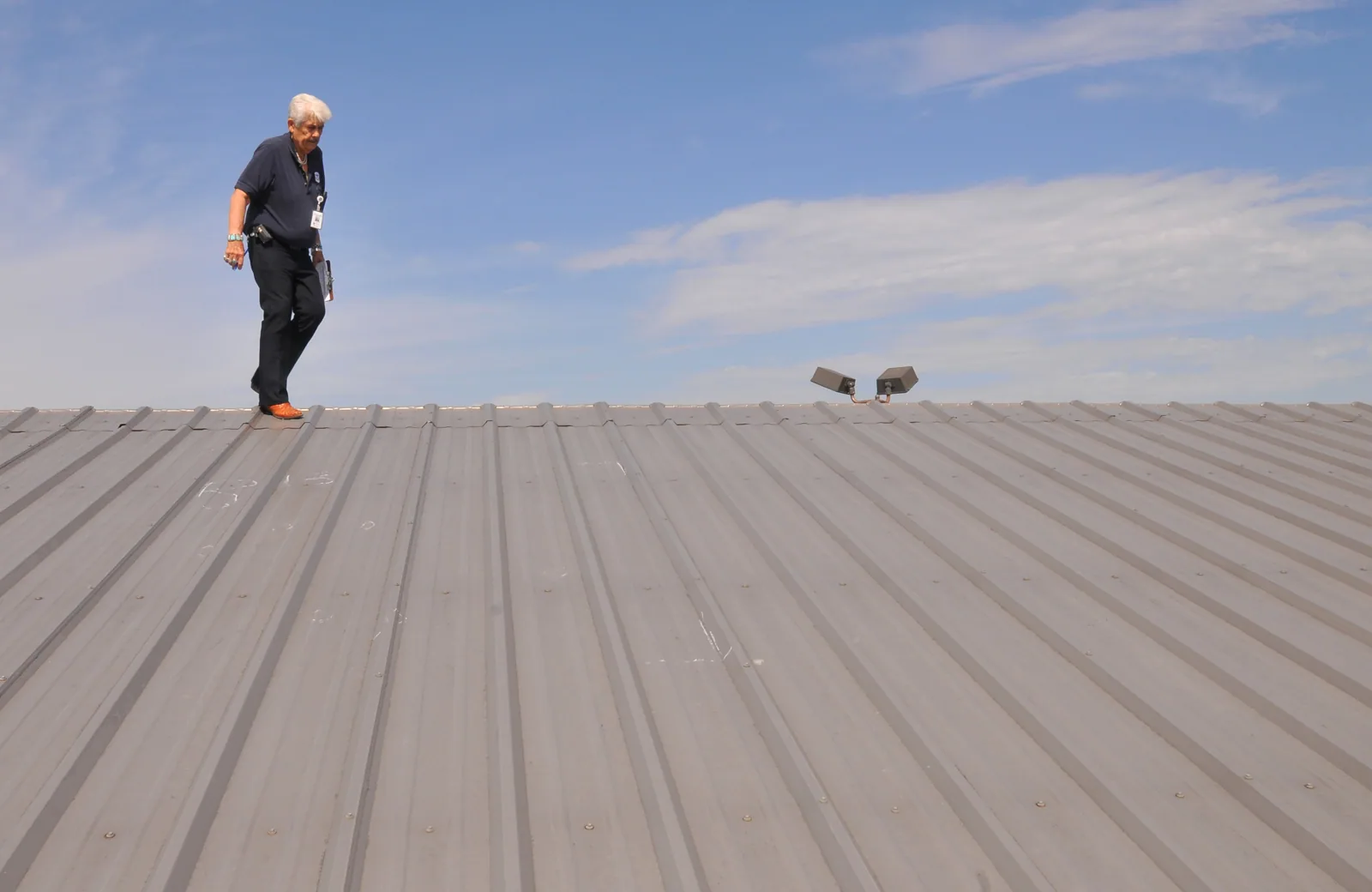
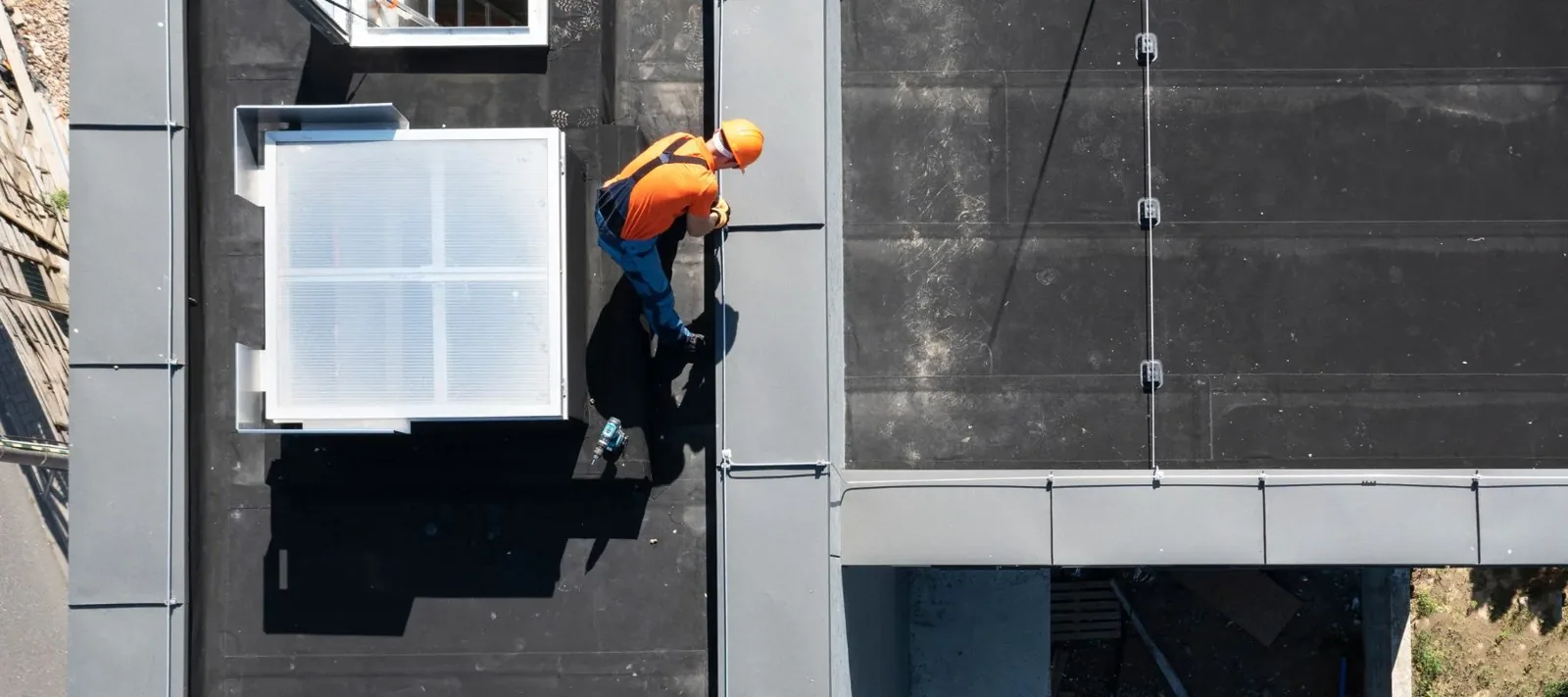
The survey is a hands-on walk, not a look from the edge. We cover the membrane or metal surface, seams, flashing, penetrations, drains and scuppers, edge metal, and rooftop equipment. We record the roof type and how it is attached. We photograph defects and mark them on a plan, then rank them.
- Surface and seams: splits, open laps, blisters, punctures, fastener backout and wear from foot traffic.
- Drainage: ponding, clogged drains, missing overflow and the stains that mark past standing water.
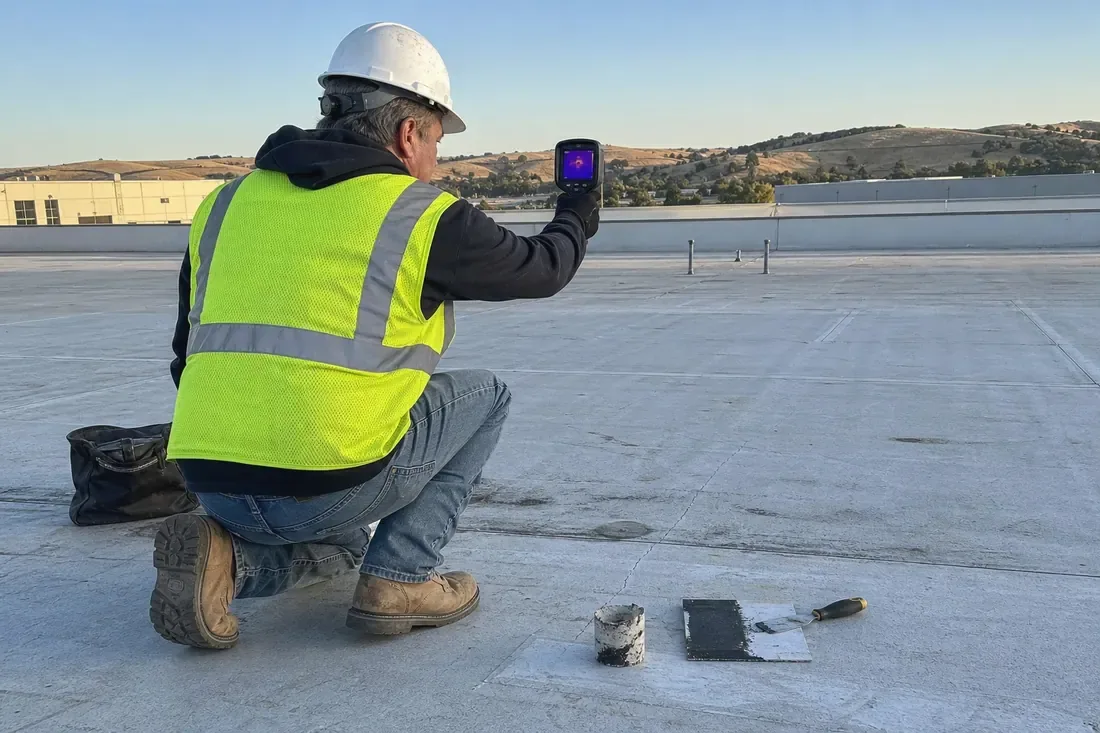
- Moisture: an infrared moisture survey and, where it matters, core cuts to confirm what the scan suggests.
- Equipment and details: curbs, supports, skylights and penetrations that leak first.
On large buildings we add a drone roof inspection so every area gets looked at, including the parts too awkward or fragile to cross on foot.
Reading a Dry Roof: finding last summer's story
Even on a dry day, a roof tells you how it has behaved. Rings of dried residue show where ponds sat. Patches pile up near drains and units, which tells us where water has been getting in. Discoloration along seams, algae lines, brittle sealant and fresh mastic over old mastic all point to a history the seller may not have mentioned.
We also look underneath. Wet insulation does not announce itself, and in a climate with dewpoints in the 70s and near-daily storms for months, it does not take long for a small entry point to soak a large area. If the scan shows a suspicious area, we say what it means for the budget: a repair, a partial replacement or a reason to renegotiate. A survey in February can be as useful as one in July, as long as it knows what to look for.
Numbers for the Deal: repairs now, reserves later
A buyer wants two lists. One is what has to be fixed at or soon after closing. The other is what the building will need over the next several years. The survey provides both. Immediate items are the open seams, failed flashing and clogged drains that could cause damage in the next storm. Reserve items are the aging membrane, the worn coating or the lifespan left on the insulation.
We describe the cost drivers in plain terms, such as tear-off layers, wet insulation, access and the number of units to lift, and we leave exact figures for when a scope is chosen. The same findings feed a longer capital planning schedule if you keep the building. If the numbers are bigger than the price assumed, the survey gives you grounds for a credit or a changed offer, with photographs to back it up.
Code and Coverage: what a buyer inherits in the Hurricane Zone
A roof in Broward carries more than a membrane. It carries the High Velocity Hurricane Zone rules: Risk Category II buildings are designed for 170 mph, and every exterior roofing component needs a Miami-Dade product approval. Any replacement a buyer plans after closing is permitted under the 8th Edition of the Florida Building Code as things stand, with the 9th Edition due by the end of 2026. Knowing which edition governs a future permit is part of knowing the roof's price.
Storm history matters too. Wilma damaged roofs across Broward in 2005, and Irma followed in 2017, when gusts ran 80 to 100 mph over most of Broward. We look for old storm repairs and see whether any manufacturer warranty is still alive and transferable to a new owner. A written condition report packages all of this for the lender.
Industrial Parks: where the big buildings sit
Pompano Beach is the biggest industrial and distribution submarket in Broward, with upwards of 28 million square feet to its name. The area's mix of logistics campuses, multi-tenant flex parks and smaller buildings makes property-by-property diligence essential. These large-footprint, low-slope facilities illustrate the warehouse roofs common across the local submarket. The IDI Pompano Business Center and Alpha 250 industrial park profiles provide regional context; an acquisition survey still needs building-specific observations and photographs.
A real estate investor or REIT assembling several buildings can have the survey scaled across the group, with the same format used for each building so they can be compared.
Questions We Hear Often
How fast can a survey be turned around?
Fast enough for a normal inspection period once access is lined up. A single building is usually walked in a day, with the written findings following shortly after.
Will the seller have to allow core cuts?
Only if the scan points to wet insulation, and only in a few spots, patched the same day. Most surveys finish without one, and the seller can approve the locations beforehand.
Does a survey in the dry season miss leaks?
It misses active drips, not the evidence they leave behind. Stains, patches, ponding marks and moisture scans show what the wet season did, and we say plainly what a dry-day walk cannot prove.
What if the survey finds wet insulation?
Then the question becomes how much, and where. We map the wet area, estimate the repair or replacement scope and give you the cost drivers so the price can be adjusted before closing.
Can several buildings be surveyed together for one purchase?
Yes. We use one format for the whole group so the buildings can be ranked against each other, and we schedule the walks to finish inside the same contract window.